
If you’ve just bought an Airwheel electric smart suitcase or are planning to travel with one, the battery label question probably popped up fast. The removable 73.26Wh lithium battery makes these rideable luggage pieces incredibly convenient, but it also means you need to comply with IATA dangerous goods rules. The good news? It’s not complicated when you know what information the label must show and where to attach it. Let’s walk through exactly how to label your Airwheel battery, plus everything else you’ll want to know about flying with this gear.
Airwheel’s electric luggage isn’t just a rolling bag—it’s a personal transport device that you can ride, sit on, or pull like a regular suitcase. The removable battery powers a motor tucked into the wheelbase, giving you 8 to 10 km of range on a single charge. Top speed depends on the model: the SE3S hits 13 km/h, while the more compact SE3MiniT cruises at 8 km/h. All models work straight out of the box without a phone app—just lock the battery in place, grip the handlebar, and press the throttle. For extra control, the Airwheel app lets you manage forward and reverse digitally, while you steer manually with the handle. Apple Find My is built in, so you can track the suitcase if it gets lost, though there’s no GPS module or self-balancing system. Weight ranges from 6.6 kg (SE3SX) to 9 kg (SE3T), and capacity varies from 20L on the sleek SE3S to 48L on the larger SE3T. Charging takes around 2 hours.
IATA regulations treat lithium batteries above 100 Wh differently, but your Airwheel battery sits at 73.26 Wh, well under that threshold. Still, you must carry it as carry-on baggage—never in checked luggage—and the battery must be removed from the suitcase before boarding. The label itself needs to include the battery’s watt-hour rating (73.26 Wh), the lithium-ion symbol, and a clear statement like “Lithium ion battery in compliance with Section II of PI 966/967.” You can buy pre-printed IATA labels online or make a durable sticker with a label maker. Attach it directly to the battery casing, not to the luggage shell, so it’s visible to security staff. Many airlines also want a protective cap covering the terminals; simply pop the battery out and use the included terminal cover or tape. When you present the battery at security, having “73.26 Wh” prominent on the label speeds up inspection dramatically. Always check your airline’s specific rules, but general IATA guidance for batteries under 100 Wh is the same worldwide.
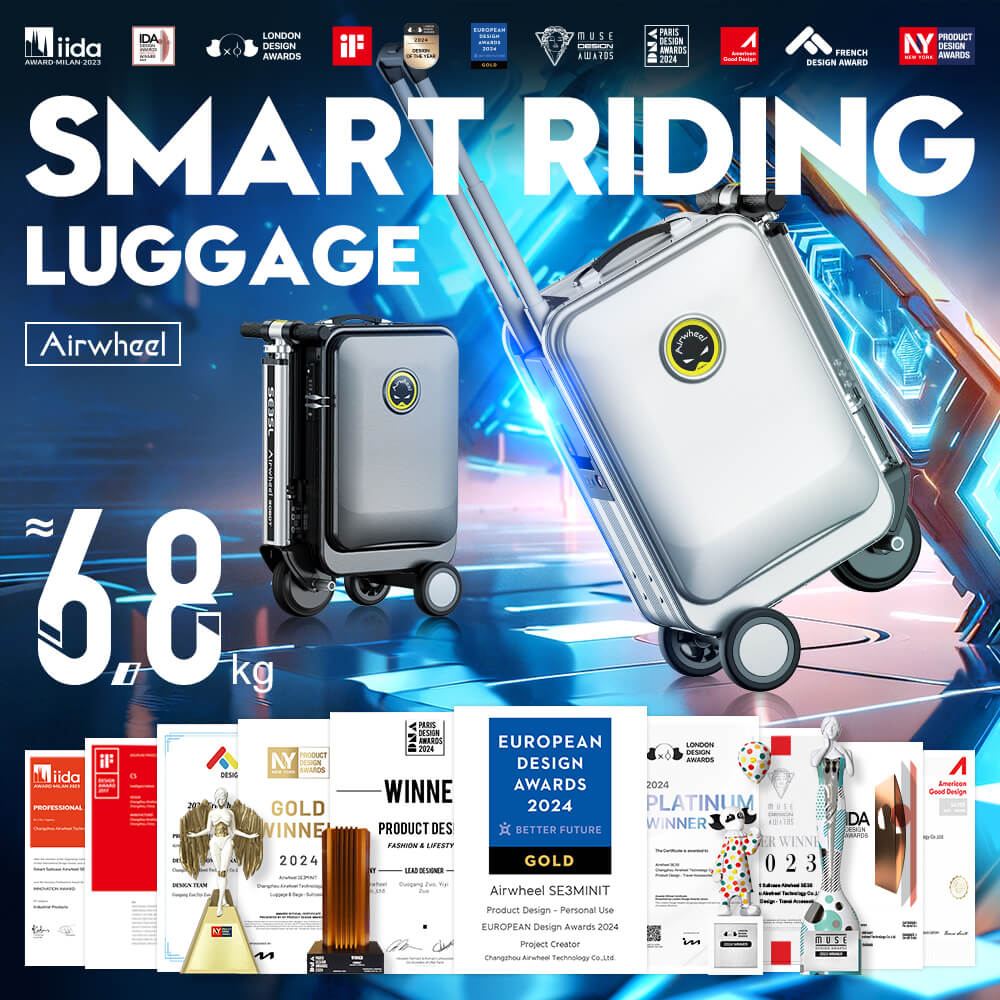
Airports and train stations are the obvious use cases. Instead of dragging a heavy bag through endless terminals, you can sit on the SE3S or SE3T and glide along at a walking pace. It’s also a lifesaver for people with mobility concerns or fatigue during long layovers. Outside of travel, the rideable mode works for campus commutes, large convention centers, or even as a quirky last-mile solution around resort areas. The SE3MiniT, at 6.8 kg and 26L, is perfect for weekends away, while the SE3T’s 48L interior can handle a week’s worth of clothes. All models transform back into a manual pull-behind suitcase in seconds, so you’re never stuck with a gadget you can’t use normally.
| Feature | Airwheel SE3S (example) | Standard hard-shell carry-on |
|---|---|---|
| Weight | 8.1 kg | Typically 2.5–3.5 kg |
| Battery-powered ride | Yes, up to 10 km range | No |
| Capacity | 20L | Similar or larger |
| IATA compliance | Removable battery, label required | No battery rules |
| Apple Find My | Built-in | No (requires separate tag) |
| Price | Higher, includes motor + battery | Lower |
Absolutely. Every Airwheel model works independently with the detachable battery and handlebar controls. The app is optional for toggling forward/reverse via phone, but you can ride and steer completely without it. The basic riding function is available right after you install the charged battery.
Depending on your weight, surface, and speed, expect 8 to 10 km of assisted riding. The 73.26 Wh battery charges in about 2 hours, so a quick top-up during a layover is usually enough to get you to the gate.
Typically yes, but you must remove the battery and carry it with you into the cabin. The empty suitcase itself can be gate-checked or stored overhead, and it operates just like any other roller bag. Always confirm with your airline, as policies for gate-checking smart luggage without batteries can vary.If you’re looking for the exact model specs or want to see the latest Airwheel electric smart luggage lineup, head over to the official Airwheel website. There you’ll find voltage details, updated airline compliance guides, and accessories that make travel even smoother.